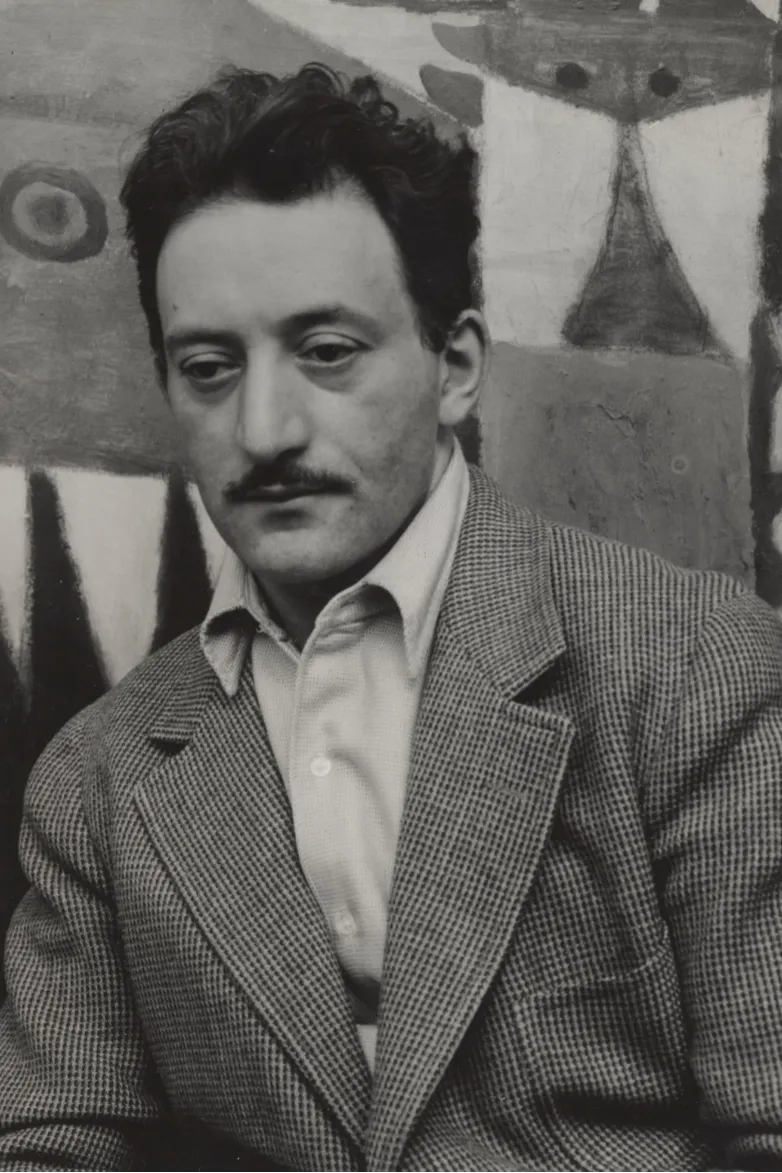
Personal info
Known for
Ultimate Talent
Gender
Male
Birthday
14 March
Location
New York, United States
Edit pageAdolph Gottlieb
Biography
Adolph Gottlieb (March 14, 1903 – March 4, 1974) was an American painter, sculptor, and printmaker who became one of the leading figures of the Abstract Expressionist movement. Renowned for his bold abstract compositions and symbolic imagery, Gottlieb sought to express universal human emotions through simplified forms, dramatic colors, and expressive brushwork. His work helped establish New York as a major center of modern art in the mid-20th century.
Early Life and Education
Adolph Gottlieb was born in New York City, United States, to Jewish immigrant parents. From an early age, he showed an interest in art and left high school to pursue artistic training. At the age of 17, he traveled to Europe, where he spent a year visiting museums and studying the works of the Old Masters and modern European artists.
After returning to New York, Gottlieb continued his education at the Art Students League of New York, the Parsons School of Design, and the Educational Alliance Art School. These experiences helped shape his artistic development while introducing him to fellow artists who would later become prominent figures in American modernism.
Career
Gottlieb began his career in the 1920s as a representational painter but gradually shifted toward abstraction. During the 1930s, he became active in New York's modern art community and participated in exhibitions promoting contemporary American art.
In the early 1940s, Gottlieb developed his celebrated "Pictograph" series, featuring abstract symbols arranged in grid-like compositions. Influenced by mythology, archaeology, Indigenous art, and psychology, these paintings reflected his belief that universal symbols could communicate shared human experiences.
By the 1950s, he moved toward a more simplified style, creating his well-known "Burst" paintings. These works typically feature a floating circular form above an energetic, brush-filled lower section, using striking contrasts of color and shape to evoke emotional intensity.
Throughout his career, Gottlieb exhibited extensively in the United States and internationally, earning recognition as one of the pioneers of Abstract Expressionism.
Artistic Style
Adolph Gottlieb's work is characterized by:
- Bold abstract compositions.
- Symbolic and myth-inspired imagery.
- Expressive use of color and texture.
- Large-scale canvases.
- Simplified geometric and organic forms.
- Emotional and philosophical themes.
Rather than depicting recognizable subjects, Gottlieb aimed to communicate universal ideas and emotional states through abstract visual language.
Notable Works
Some of Adolph Gottlieb's most celebrated works include:
- Eyes of Oedipus (1942)
- The Seer (1950)
- Blast I (1957)
- Burst series
- Pictograph series
- Imaginary Landscape series
These paintings remain among the defining works of American Abstract Expressionism.
Awards and Recognition
During his lifetime, Gottlieb received widespread acclaim for his artistic achievements. His works were featured in major international exhibitions and entered the collections of leading museums worldwide.
His paintings are held in institutions such as the Museum of Modern Art (MoMA), the Whitney Museum of American Art, the Metropolitan Museum of Art, the National Gallery of Art, and numerous other public and private collections.
Personal Life
Gottlieb married Esther Deutch in 1935, and they remained together throughout his life. Despite suffering a stroke in 1970 that limited the use of one arm, he continued painting with determination and produced several significant works during his final years.
Death
Adolph Gottlieb died on March 4, 1974, in New York City, just ten days before his 71st birthday.