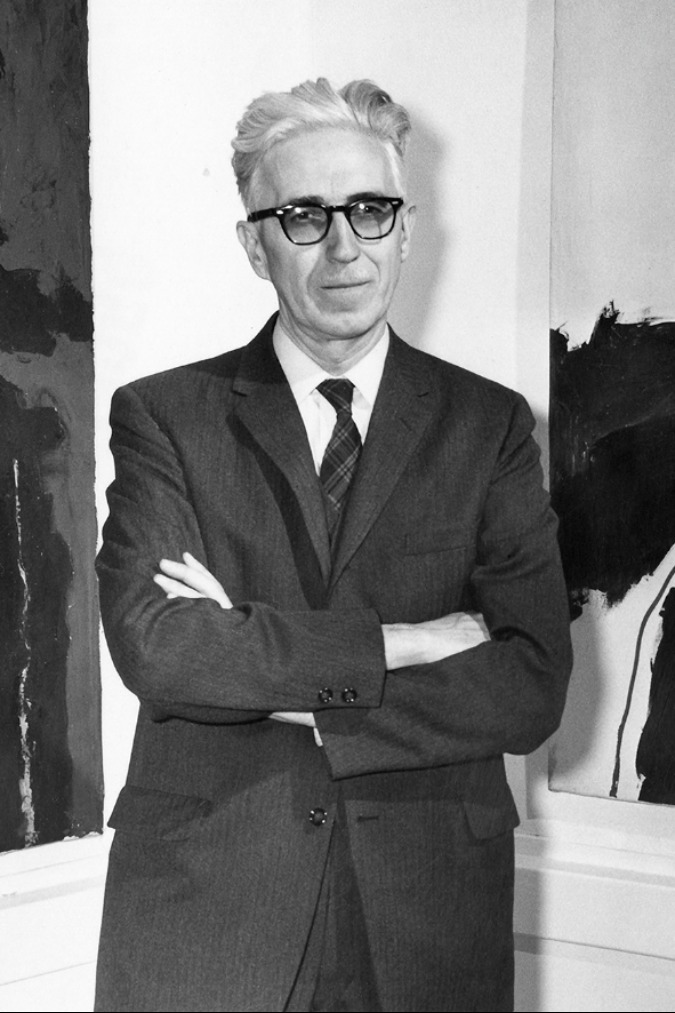
Personal info
Known for
Ultimate Talent
Gender
Male
Birthday
30 November
Location
North Dakota, United States
Edit pageClyfford Still
Biography
Clyfford Still (November 30, 1904 – June 23, 1980) was an American painter and one of the pioneers of Abstract Expressionism, an influential modern art movement that emerged after World War II. He was particularly recognised for his large-scale abstract paintings featuring dramatic colours, irregular shapes and textured surfaces. His innovative approach helped transform American painting during the 20th century.
Early Life and Education
Clyfford Still was born on November 30, 1904, in Grandin, North Dakota, United States. He spent much of his childhood in Spokane, Washington, and southern Alberta, Canada, where his family's farming background and the surrounding landscapes influenced his artistic imagination.
He attended Spokane University and later studied briefly at the Art Students League in New York in 1925. In 1933, he joined Washington State College, where he continued his studies and subsequently became an art teacher. He received his master's degree in 1935 and remained associated with the institution until 1941.
Career
Still began his artistic career creating paintings influenced by landscapes, people and industrial subjects. However, during the late 1930s and early 1940s, he gradually moved away from representational painting and developed a distinctive abstract style.
In 1943, he held his first solo exhibition at the San Francisco Museum of Art. During the same period, he met fellow artist Mark Rothko, with whom he developed an important professional friendship. He later moved to Richmond, Virginia, where he taught at the Richmond Professional Institute.
In 1945, Still travelled to New York, where he became connected with the emerging Abstract Expressionist movement. Art collector Peggy Guggenheim organised his solo exhibition at her gallery, Art of This Century, in 1946. He subsequently exhibited at the Betty Parsons Gallery and became associated with several leading modern artists.
From 1946 to 1950, he taught at the California School of Fine Arts in San Francisco, where he influenced a younger generation of artists through his teaching and experimental approach to painting.
During the 1950s, Still became increasingly dissatisfied with commercial galleries and the art establishment. He gradually withdrew from the New York art scene and stopped working with commercial galleries in 1951. In 1961, he settled on a farm near Westminster, Maryland, where he continued painting in relative isolation.
In 1979, the Metropolitan Museum of Art in New York organised a major retrospective of his work, recognising his significant contribution to modern American art.
Notable Works and Artistic Style
Still was known for his powerful abstract compositions, featuring jagged shapes, irregular colour fields and heavily textured paint surfaces. He frequently used palette knives to apply thick layers of pigment to large canvases. His paintings often featured contrasting shades of black, red, yellow, orange and blue.
Some of his notable works include:
PH-247 (1946)
PH-385 (1949)
1951-A (1951)
PH-571 (1951-N) (1951)
PH-578 (1965)
He generally avoided giving descriptive titles to his paintings, preferring numbers and codes so viewers could interpret them independently.
Personal Life and Death
Still married Lillian August Battan in 1930, and they had two daughters. The couple later divorced. In 1957, he married Patricia Alice Gankin, who remained his companion during the later years of his life.
Clyfford Still died on June 23, 1980, in Baltimore, Maryland, at the age of 75.