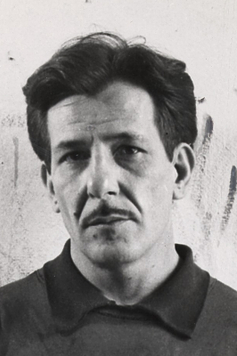
Personal info
Known for
Ultimate Talent
Gender
Male
Birthday
23 May
Location
Pennsylvania, United States
Edit pageFranz Kline
Biography
Franz Kline (May 23, 1910 – May 13, 1962) was an American painter best known for his bold, large-scale black-and-white abstract paintings that became iconic examples of Abstract Expressionism. Renowned for his energetic brushwork and dramatic compositions, Kline played a leading role in the postwar New York art scene. Although often associated with monochromatic paintings, he also produced vibrant color works later in his career. His expressive style and innovative approach to abstraction made him one of the most influential American artists of the 20th century.
Early Life and Education
Franz Kline was born on May 23, 1910, in Wilkes-Barre, Pennsylvania, United States. After the death of his father, he spent part of his childhood in foster care before pursuing his interest in art.
He studied at Boston University from 1931 to 1935 before attending the Heatherley School of Fine Art in London. During his early years, Kline focused on academic drawing and figurative painting, developing strong technical skills that later informed his abstract work.
In the late 1930s, he settled in New York City, where he became part of a vibrant community of artists and intellectuals.
Career
Kline initially worked as a figurative painter and illustrator. During the 1940s, his friendship with fellow artist Willem de Kooning encouraged him to experiment with abstraction. According to a well-known account, de Kooning projected one of Kline's sketches onto a wall using a projector, revealing the powerful impact of its enlarged black forms. This experience inspired Kline to develop the monumental abstract style for which he became famous.
By the late 1940s, Kline had emerged as one of the leading members of the New York School of Abstract Expressionism, alongside artists such as Jackson Pollock, Mark Rothko, Barnett Newman, and Willem de Kooning.
His paintings are characterized by sweeping black brushstrokes set against white backgrounds, creating compositions that resemble architectural structures or calligraphic writing. Although many viewers interpret his work as spontaneous, Kline carefully planned his compositions through numerous preparatory sketches.
During the late 1950s, he expanded his palette to include vibrant colors while maintaining the expressive energy of his brushwork. His work was exhibited internationally and helped establish American abstract painting as a dominant force in modern art.
Artistic Style
Franz Kline's work is characterized by:
- Bold black-and-white compositions.
- Dynamic, expressive brushstrokes.
- Monumental scale.
- Abstract forms inspired by architecture and urban landscapes.
- Energetic gestural painting.
- Strong contrasts of light and dark.
- Later experimentation with vivid color.
His paintings emphasize movement, rhythm, and the physical act of painting.
Notable Works
Some of Franz Kline's most celebrated works include:
- Chief (1950)
- Painting No. 2 (1954)
- Mahoning (1956)
- New York, N.Y. (1953)
- Orange and Black Wall (1959)
- Le Gros (1961)
These works are considered masterpieces of Abstract Expressionism and remain central to the history of modern art.
Awards and Recognition
Although Kline died relatively young, he achieved international recognition during his lifetime. His paintings were exhibited in major galleries and museums across the United States and Europe.
Today, his works are held in the collections of the Museum of Modern Art (MoMA), the Whitney Museum of American Art, the Metropolitan Museum of Art, the Solomon R. Guggenheim Museum, the Tate Modern, the National Gallery of Art, and many other leading institutions.
He is regarded as one of the defining figures of the Abstract Expressionist movement.
Personal Life
Franz Kline lived and worked primarily in New York City, where he was closely associated with fellow members of the New York School. Known for his wit and sociable personality, he maintained friendships with many influential artists, critics, and writers of his generation.
Despite his growing international success, Kline remained committed to continually refining his artistic vision.
Death
Franz Kline died on May 13, 1962, in New York City, ten days before his 52nd birthday, after suffering from rheumatic heart disease.