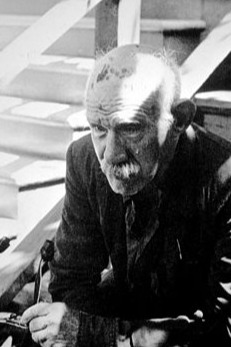
Personal info
Known for
Ultimate Talent
Gender
Male
Birthday
12 December
Location
Illinois, United States
Edit pageHenry Darger
Biography
Henry Darger was an American artist, writer, and janitor whose work was discovered only after his death. Largely unknown during his lifetime, Darger is now regarded as one of the most significant figures in outsider art. His vast illustrated epic and haunting watercolor drawings reveal an intensely private imagination shaped by trauma, faith, obsession, and moral struggle.
Early Life and Background
Henry Joseph Darger Jr. was born on April 12, 1892, in Chicago, Illinois. His early life was marked by hardship and instability. His mother died when he was young, and his father, who was disabled, was unable to care for him. Darger spent much of his childhood in institutions, including a state asylum for children with behavioral issues.
These early experiences of abandonment, authority, and confinement deeply influenced Darger’s inner world. He received little formal education and struggled socially throughout his life, developing a reclusive personality that would define his adulthood.
Adult Life and Isolation
As an adult, Darger lived alone in a small rented room in Chicago, supporting himself through menial labor, most notably as a hospital janitor. He lived an extremely private and regimented life, attending church regularly and rarely forming close relationships.
Unknown to those around him, Darger spent decades creating an enormous body of artistic and literary work in isolation. His landlords and acquaintances did not know the scope or intensity of his creative life.
The Vivian Girls and Literary Work
Darger’s primary work is a massive illustrated manuscript titled The Story of the Vivian Girls, in What Is Known as the Realms of the Unreal. This handwritten epic spans more than 15,000 pages and is accompanied by hundreds of large-scale watercolor and collage illustrations.
The narrative centers on the Vivian Girls, young heroines who fight against cruel forces in a fantastical world marked by war, enslavement, and rebellion. The story blends childlike imagery with scenes of extreme violence, reflecting Darger’s preoccupation with innocence, suffering, justice, and divine intervention.
In addition to this work, Darger created journals, weather logs, and autobiographical writings, revealing an obsessive attention to detail and a need to impose order on the world.
Artistic Style and Methods
Darger’s visual work is characterized by bright colors, flattened perspectives, and repeated figures traced or copied from newspapers, magazines, and children’s books. He often used collage and tracing to construct complex scenes filled with action and symbolism.
A striking and controversial aspect of his work is the frequent depiction of children, often portrayed with ambiguous or anatomically incorrect bodies. Scholars interpret these images in various ways, often linking them to Darger’s limited anatomical knowledge, religious symbolism, and fixation on innocence rather than sexual intent.
His style resists traditional artistic categories, combining folk art, illustration, and personal mythology into a singular visual language.
Discovery and Recognition
Henry Darger’s work was discovered after he died in 1973, when his landlords found the massive manuscript and artworks left behind in his room. Recognizing their unusual power, they preserved and later shared the material with scholars and collectors.
Since then, Darger’s work has been exhibited internationally and has become central to discussions of outsider art, mental health, and the boundaries of artistic intention.