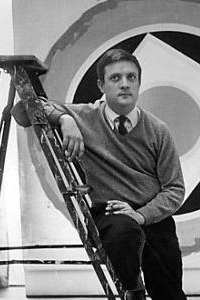
Personal info
Known for
Ultimate Talent
Gender
Male
Birthday
10 April
Location
North Carolina, United States
Edit pageKenneth Noland
Biography
Kenneth Noland (April 10, 1924 – January 5, 2010) was an American painter and one of the leading figures of Color Field painting and postwar American abstraction. Best known for his use of vivid colors, geometric forms, and repeated patterns, Noland explored the emotional and visual power of color itself. His innovative approach helped shape the development of modern abstract painting and influenced generations of artists.
Early Life and Education
Kenneth Clifton Noland was born on April 10, 1924, in Asheville, North Carolina, United States. He grew up in a family that encouraged creativity and intellectual curiosity.
During World War II, Noland served in the U.S. Air Force as a pilot. After the war, he studied art at Black Mountain College in North Carolina, where he was influenced by important modern artists and teachers.
At Black Mountain College, he studied under artists such as Josef Albers and became interested in theories of color, abstraction, and visual perception. He later traveled to Paris, where he studied European modern art and was influenced by artists including Henri Matisse and Piet Mondrian.
Career
After returning to the United States, Noland became associated with the Washington, D.C. art scene and later the New York School. He developed close relationships with artists such as Morris Louis, Helen Frankenthaler, and Clement Greenberg, who supported the development of Color Field painting.
In the 1950s, Noland began creating his famous Target paintings, circular compositions made of concentric rings of color. These works focused on the interaction of colors rather than traditional subjects or imagery.
During the 1960s and 1970s, Noland expanded his experiments with geometric shapes, creating Stripes, Chevrons, and shaped canvases. He explored how colors could create movement, balance, and emotional effects without relying on recognizable images.
Throughout his career, Noland taught at several institutions, including Catharine Gibbs School, Hunter College, and Yale University, influencing many younger artists.
Artistic Style
Kenneth Noland's work is characterized by:
- Color Field painting.
- Geometric abstraction.
- Bold use of color.
- Circular targets and stripe patterns.
- Shaped canvases.
- Emphasis on visual experience.
- Minimal imagery and focus on pure form.
His paintings often removed personal expression and narrative, allowing color relationships to become the main subject.
Notable Works
Some of Kenneth Noland's most important works include:
- Target series (1950s–1960s)
- Beginning (1958)
- Turnsole (1961)
- Gift (1961)
- Split series
- Chevron series
- Stripe series
These works demonstrate his lifelong exploration of color, space, and composition.
Awards and Recognition
Noland received major recognition during his career and was considered one of America's most important abstract painters. His works are included in major museum collections, including the Museum of Modern Art (MoMA), the National Gallery of Art, the Whitney Museum of American Art, and the Solomon R. Guggenheim Museum.
He received numerous honors and participated in important international exhibitions, including the Venice Biennale and major American museum retrospectives.
Personal Life
Kenneth Noland was married several times, including marriages to Cornelia Fort and Stephanie Gordon. He maintained studios in various locations, including Vermont, New York, and France.
He remained dedicated to exploring new possibilities in abstract painting throughout his long career.
Death
Kenneth Noland died on January 5, 2010, in Port Clyde, Maine, at the age of 85.