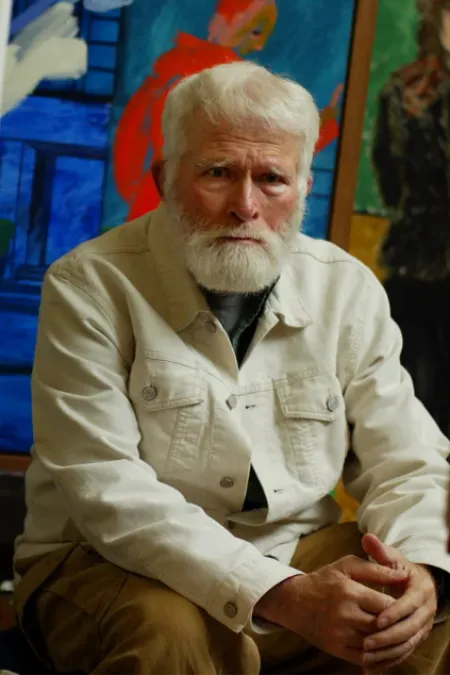
R.B. Kitaj
Biography
R. B. Kitaj (born Ronald Brooks Kitaj; October 29, 1932 – October 21, 2007) was an American painter, draftsman, printmaker, and writer whose intellectually rich and figurative works made him one of the most influential artists of the postwar era. Although American by birth, Kitaj spent much of his career in the United Kingdom and became a leading figure in the School of London, alongside artists such as Francis Bacon, Lucian Freud, Frank Auerbach, and Leon Kossoff. His paintings combined references to history, literature, philosophy, politics, and Jewish identity, creating visually complex and thought-provoking compositions.
Early Life and Education
R. B. Kitaj was born on October 29, 1932, in Cleveland, Ohio, United States. His father left the family when Kitaj was a child, and he was raised primarily by his mother, Jeanne Brooks. After his mother remarried, he adopted the surname Kitaj from his stepfather.
As a young man, Kitaj served in the United States Merchant Marine, traveling extensively and developing an interest in world history and culture. He later studied art at the Cooper Union in New York City, the Akademie der Bildenden Künste in Vienna, and the Ruskin School of Drawing and Fine Art at the University of Oxford. He completed his formal training at the Royal College of Art in London, where he studied alongside several artists who would later become prominent figures in British art.
Career
Kitaj settled in London during the late 1950s and quickly established himself as an important figurative painter. While many artists of the period embraced abstraction, he remained committed to narrative painting, incorporating references from literature, classical mythology, psychoanalysis, politics, and modern history.
Throughout the 1960s and 1970s, Kitaj exhibited widely across Europe and North America. His paintings often included written notes or explanatory texts, encouraging viewers to explore the intellectual ideas behind his compositions.
He played a key role in defining the School of London, a group of figurative artists who continued to focus on the human figure during a period dominated by abstract and conceptual art.
One of the defining themes of Kitaj's later career was the exploration of his Jewish heritage. Following the publication of his influential essays on Diasporism, he created numerous paintings examining Jewish identity, exile, memory, and history.
After the death of his wife, artist Sandra Fisher, in 1994, Kitaj left London and returned to Los Angeles, where he continued painting until his death.
Artistic Style
R. B. Kitaj's work is characterized by:
- Figurative compositions.
- Literary, historical, and philosophical references.
- Bold, expressive color.
- Layered symbolism and narrative.
- Exploration of Jewish identity and diaspora.
- Dynamic drawing and printmaking.
- Intellectual and autobiographical themes.
His paintings often reward careful study, revealing multiple layers of meaning and cultural reference.
Notable Works
Some of R. B. Kitaj's most celebrated works include:
- If Not, Not (1975–1976)
- The Ohio Gang (1964)
- The Autumn of Central Paris (1972–1973)
- The Wedding (1989–1993)
- Cecil Court, London W.C.2 (1962)
- First Diasporist Manifesto (published essay, 1989)
These works exemplify his distinctive fusion of visual art, literature, and historical reflection.
Awards and Recognition
Kitaj achieved international recognition throughout his career and represented Britain at the Venice Biennale in 1967. In 1991, he was elected to the Royal Academy of Arts, becoming one of the few American-born artists to receive this distinction.
His paintings are held in major collections, including the Tate, the Museum of Modern Art (MoMA), the Metropolitan Museum of Art, the National Gallery of Art, the British Museum, and many other leading museums.
Personal Life
Kitaj married American painter Sandra Fisher in 1983, and the couple had one son. Fisher's sudden death in 1994 profoundly affected him and became a recurring theme in his later work.
A passionate reader and writer, Kitaj believed that painting should engage with literature, philosophy, and history, making intellectual inquiry central to his artistic practice.
Death
R. B. Kitaj died on October 21, 2007, in Los Angeles, California, just eight days before his 75th birthday.