Personal info
Known for
Ultimate Talent
Gender
Male
Birthday
27 April
Location
Massachusetts, United States
Edit pageSamuel F.B. Morse
Biography
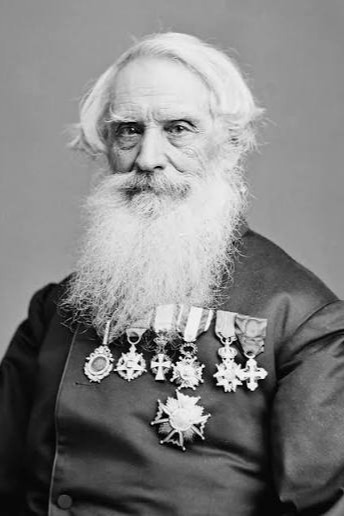
Samuel Finley Breese Morse (April 27, 1791 – April 2, 1872) was an American painter, inventor, and educator best known as the co-developer of the Morse code and the inventor of the practical single-wire telegraph system. Before becoming famous for his technological achievements, Morse was a respected portrait painter and one of the founders of the National Academy of Design. His contributions to communication and American art made him one of the most influential figures of the 19th century.
Early Life and Education
Samuel F. B. Morse was born on April 27, 1791, in Charlestown, Massachusetts, United States. He was the son of Jedidiah Morse, a prominent geographer and clergyman, and Elizabeth Finley Morse.
Morse showed an early interest in art and science. He attended Phillips Academy in Andover and later studied at Yale College, where he developed interests in electricity, philosophy, and painting. After graduating from Yale in 1810, he pursued an art career.
In 1811, Morse traveled to England with American painter Washington Allston to study at the Royal Academy of Arts in London. There he learned European painting techniques and was influenced by classical and Renaissance traditions.
Career as an Artist
Morse began his career as a portrait painter and became one of America's leading artists of the early 19th century. He specialized in portraits of prominent political, cultural, and intellectual figures.
After returning to the United States, he gained recognition for his skillful portraits and historical paintings. His work reflected the influence of European academic painting and emphasized realism, composition, and detailed character studies.
One of his most ambitious paintings was Gallery of the Louvre (1831–1833), which depicted a fictional gallery containing copies of famous European masterpieces. The work demonstrated his admiration for European art and his desire to introduce artistic education to American audiences.
Morse helped establish the National Academy of Design in New York in 1826 and served as its first president. The institution became an important center for American art education and exhibitions.
Career as an Inventor
While returning from Europe in 1832, Morse became interested in the possibility of using electricity for long-distance communication. He began experimenting with telegraph technology and developed a practical single-wire electric telegraph.
With assistance from scientists and collaborators, including Alfred Vail, Morse created a system for transmitting messages using coded electrical signals. This led to the development of Morse code, a system of dots and dashes representing letters and numbers.
In 1844, Morse sent the famous first official telegraph message from Washington, D.C., to Baltimore, Maryland: "What hath God wrought."
His invention revolutionized communication, allowing information to travel rapidly across great distances and laying the foundation for modern telecommunications.
Artistic Style
Samuel F. B. Morse's paintings are characterized by:
- Academic realism.
- Detailed portraiture.
- Historical subjects.
- Classical European influences.
- Careful composition and technical precision.
- Interest in cultural and intellectual figures.
His artwork reflected the artistic traditions he studied in Europe.
Notable Works
Some of Samuel F. B. Morse's important artworks include:
- Gallery of the Louvre (1831–1833)
- Dying Hercules (1812)
- Portrait of Marquis de Lafayette (1825)
- Portraits of American leaders and intellectuals
- Historical and religious paintings
Awards and Recognition
Morse received international recognition for his invention of the telegraph and Morse code. He was honored by scientific organizations and governments around the world for transforming global communication.
His paintings are preserved in major collections, including the Metropolitan Museum of Art, the National Gallery of Art, and the Smithsonian American Art Museum.
Personal Life
Morse married Lucretia Walker in 1818, and they had three children. His wife's sudden death in 1825 deeply affected him and influenced his later interest in faster communication methods.
In 1848, Morse married Sarah Elizabeth Griswold, with whom he had four children.
Throughout his life, Morse maintained interests in both art and science, seeing creativity and invention as connected forms of human achievement.
Death
Samuel F. B. Morse died on April 2, 1872, in New York City, at the age of 80.