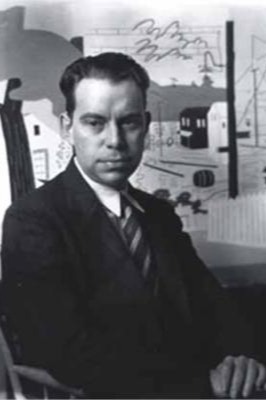
Personal info
Known for
Ultimate Talent
Gender
Male
Birthday
07 December
Location
Pennsylvania, United States
Edit pageStuart Davis
Biography
Stuart Davis was a pioneering American modernist painter whose bold colors, jazz-inspired rhythms, and innovative compositions made him one of the most important figures in 20th-century American art. His work bridged realism and abstraction, helping to shape the development of modern art in the United States.
Early Life and Education
Stuart Davis was born on December 7, 1892, in Philadelphia, Pennsylvania, USA. He grew up in an artistic environment; his father was an art editor for a newspaper, and his mother was a sculptor. This creative upbringing strongly influenced his decision to pursue art.
Davis studied at the New York School of Art under Robert Henri, a leader of the Ashcan School, which emphasized realistic depictions of everyday urban life. Early in his career, Davis painted city scenes, storefronts, and working-class neighborhoods, reflecting this influence.
Early Career and Modernist Influence
In 1913, Davis exhibited work in the groundbreaking Armory Show in New York, which introduced European modernism to American audiences. The exhibition profoundly impacted him, exposing him to artists such as Picasso and Matisse.
Inspired by Cubism and modern European styles, Davis gradually moved toward abstraction. However, unlike many European modernists, he rooted his art in distinctly American subjects—jazz music, advertising signs, cigarette packages, and urban imagery.
Mature Style and Artistic Evolution
By the 1920s and 1930s, Stuart Davis had developed a signature style characterized by:
Bold, flat areas of color
Rhythmic compositions
Fragmented forms
Use of text and commercial imagery
Jazz music strongly influenced his artistic rhythm and structure. He often described his paintings as visual equivalents of jazz improvisation, full of movement and syncopation.
His work became increasingly abstract, yet it retained references to everyday American culture, blending high art with popular imagery in a way that anticipated later Pop Art movements.
Role During the Great Depression
During the 1930s, Davis was active in artists’ organizations and supported government-sponsored art programs such as the Works Progress Administration (WPA). He believed strongly in the role of art in public life and engaged with political and social discussions of the era.
His paintings from this period maintained their energetic style while reflecting broader social awareness.
Later Career and Recognition
In the 1940s and 1950s, Davis continued refining his abstract approach, becoming an influential figure for younger generations of American artists. Though Abstract Expressionism rose to prominence during this time, Davis maintained his distinctive blend of structure, color, and rhythmic design.
He exhibited widely and gained recognition as one of America’s leading modern painters. His work was featured in major museums and collections across the country.
Death and Enduring Impact
Stuart Davis passed away on June 24, 1964, in New York City. Today, his works are held in major institutions such as the Museum of Modern Art and the Whitney Museum of American Art.